Flameless candles for assisted living deserve a decision based on the actual product, the way the space operates, and the maintenance someone will perform. This guide uses Zabicat’s current listing details as the factual product context, then separates those facts from practical editorial advice about fit, placement, control, and care.
The aim is not to make an electronic candle sound like a burning candle. For flameless candles for assisted living, shoppers should judge a stable body, a flame-shaped LED component, the correct power routine, and a scene where the product can be used honestly. Measurements and product instructions should always take priority over a staged photograph.
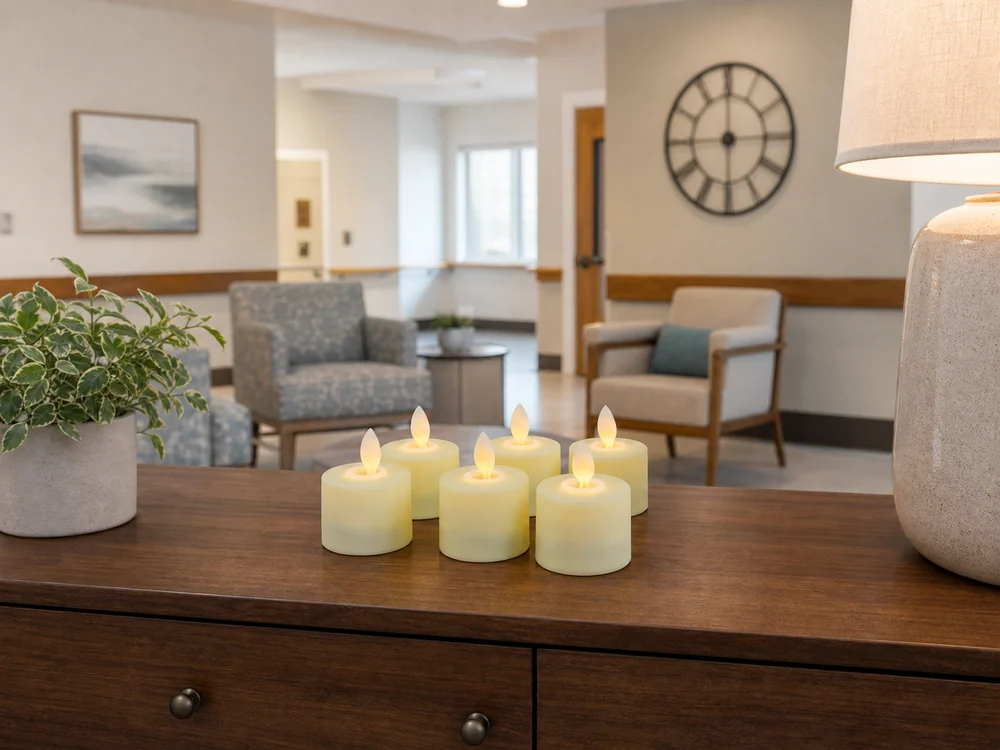
Product context: Review the primary Zabicat product, compare this related electronic candle option, and read the relevant Zabicat guide. The primary listing specifies 12 short beige plastic candles, each about 3.7 cm in diameter and 4.8 cm high, with warm white moving light, an included CR2032 button cell, and a listed battery life of about 24 to 48 hours.
Flameless Candles for Assisted Living Require Facility Approval
Flameless candles for assisted living can provide a warm electronic accent without a burning wick, hot wax, smoke, or soot. That difference may support seasonal or common-room decoration, but it does not replace facility approval. Administrators, nursing, life enrichment, facilities, infection prevention, risk management, and family representatives may each have relevant requirements.
Define the exact use before selecting a product: supervised activity, dining event, lobby display, resident room, memory-care unit, or temporary holiday program. Approval for one zone does not imply approval everywhere. Record who owns the equipment, who can operate it, and when it must be removed rather than leaving the decision to individual shifts.
Assess Resident Access and Button-Cell Risk
The referenced short pillars include CR2032 button cells according to the listing. Small batteries require controlled storage and intact compartments, especially where residents, visiting children, or pets may reach them. Check that every cover closes securely and remove a candle immediately if a cell, door, or fastener is missing.
Resident needs and abilities differ. A moving point of light may attract touch, while a small lightweight body can be picked up or placed in a pocket. Consult the care team rather than making assumptions based on age. In some areas, a larger fixed display or no candle-style device may be the correct choice.
Keep Walking Routes and Furniture Clear
Use a wide, level console set back from the main walking route. Keep candles away from tray edges, handrails, transfer areas, dining service paths, and surfaces residents use for support. Wheelchairs, walkers, carts, sleeves, and bags need predictable clearance. Decor should never narrow an accessible route or obscure a call device.
Short pillars have a low profile, but quantity can still create clutter. Group a small number with clear space between them and avoid loose trays, cords, glass, or lightweight fillers. Observe the arrangement during normal room use, not only when the space is empty. Staff should be able to reach and remove every unit without leaning over residents.
Separate Ambience From Required Lighting
LED candle glow is decorative and should not replace task, corridor, emergency, or night lighting required by the facility. Check that the display does not create glare on television screens, confuse wayfinding, or produce dark pools around furniture. A calm visual accent must remain secondary to visibility and resident safety.
Review the effect during daytime, evening activities, and cleaning. Moving tips can be soothing for some viewers and distracting for others. If residents repeatedly handle, misinterpret, or avoid the display, relocate or remove it. Direct observation and care-team feedback are stronger evidence than a generic claim that candlelight is relaxing.
Create a Staff Inspection and Timer Routine
Assign inspection to an existing documented activity or environmental round. Count units, check placement, verify battery doors, note dim or irregular output, and confirm switch or timer status. Do not create an informal task that everyone assumes another department performs. A simple location sheet can show approved quantity and responsible role.
If timers are used on another approved model, observe the first full cycle and record the start. Automatic operation must not conflict with sleep, medication rounds, room closure, or quiet hours. Remove devices for maintenance and longer storage according to the manufacturer’s directions and facility battery policy.
Use Fire-Safety Guidance as One Part of Review
The U.S. Fire Administration candle guidance suggests considering battery-operated flameless candles, while the NFPA candle safety guidance explains open-flame concerns. These sources support context, but the facility’s clinical, operational, and regulatory review remains controlling.
Avoid describing an LED candle as completely safe, therapeutic, or appropriate for every resident. It is a battery device with a decorative electronic tip. Accurate wording keeps decisions focused on product condition, access, supervision, batteries, and the individual environment instead of replacing assessment with a marketing promise.
Clean and Store Under Facility Procedures
Do not spray disinfectant directly onto the candle or soak it. Follow the product instructions and the facility’s approved electronics-cleaning method. Keep the unit out of service until any required contact time and drying process is complete. A visibly clean surface does not prove that moisture has not entered a switch or battery seam.
Store candles in numbered divided slots, secure spare and depleted cells separately, and document damaged units. Review the program after several weeks: staff time, resident response, missing pieces, and cleaning compatibility. This evidence determines whether flameless candles for assisted living remain appropriate in each approved location.
Decision Notes for Flameless Candles For Assisted Living
Measure the display: Measure furniture depth, edge setback, resident reach, walking and mobility-aid clearance, line of sight for staff, and the secure storage needed for candles, remotes, and button cells. Write the dimensions beside the product listing before ordering. This small step prevents a decorative image from overriding holder fit, access, and the true amount of space available.
Identify the likely failure: The serious planning error is treating the absence of a burning wick as universal approval without assessing facility policy, resident access, cognition, swallowing risk, infection-control methods, and staff ownership. Planning around the weak point creates a more reliable result than adding features that do not solve the daily problem.
Define the routine: Obtain written facility approval, document the approved locations, count every unit and battery, inspect during each shift or activity period, and return all accessories to controlled storage. A repeatable routine is evidence that the product suits the setting. If the process sounds inconvenient before purchase, another power type, pack size, or candle shape may be the better choice.
A Practical Evaluation Worksheet
Create a one-page worksheet before buying flameless candles for assisted living. In the first column, record only facts visible on the current product page: dimensions, quantity, power source, included controls, timer choices, charging or cell requirements, body material, and light-tip design. In the second column, record facts about the destination: available width and height, holder dimensions, outlet access, moisture exposure, viewing distance, operating frequency, and the person responsible for maintenance. A product belongs on the shortlist only when both columns agree.
Then run a small scene test for flameless candles for assisted living instead of decorating the whole room at once. Use one holder or tray, photograph the candle while switched off and on, view it from the normal seated or standing position, and practice the full service step. That step may mean lifting the unit for charging, opening a battery door, cleaning a recessed top, or collecting several pieces after use. The test reveals practical friction that specifications alone cannot show, while keeping the recommendation grounded in observable evidence rather than assumptions.
Care, Storage, and Product Review
Follow the facility’s cleaning and infection-control policy, use only manufacturer-approved methods, keep electronics dry, and remove units with loose battery doors, cracks, corrosion, leakage, or unusual heat. Protect the light tips from pressure, keep accessories with the set, and stop using any piece with visible damage. Clean condition matters because dust and residue alter both close-up appearance and light spread.
For flameless candles for assisted living, review the product page again when reordering because pack contents, controls, and specifications can change. This article was checked against current Zabicat listing details on July 14, 2026. The styling recommendations are editorial guidance, not a laboratory performance test or a substitute for the manufacturer’s instructions.
FAQ
Are flameless candles allowed in every assisted-living room?
No. Facility policy, resident assessment, battery security, cleaning rules, and the approved use zone determine whether they are appropriate.
Can LED candles replace night-lights or emergency lighting?
No. Candle-style LEDs are decorative and must not replace required task, corridor, emergency, or wayfinding illumination.
Who should inspect facility flameless candles?
Assign a named department or role and include location, count, battery condition, cleaning, and switch status in a documented routine.
Bottom line: Choose flameless candles for assisted living only after the size, power routine, electronic flame shape, control method, and maintenance plan all fit the real setting. A clear product match creates better decor and fewer surprises than a purchase based only on a distant glow photo.