Rechargeable tea lights for restaurants deserve a decision based on the actual product, the way the space operates, and the maintenance someone will perform. This guide uses Zabicat’s current listing details as the factual product context, then separates those facts from practical editorial advice about fit, placement, control, and care.
The aim is not to make an electronic candle sound like a burning candle. For rechargeable tea lights for restaurants, shoppers should judge a stable body, a flame-shaped LED component, the correct power routine, and a scene where the product can be used honestly. Measurements and product instructions should always take priority over a staged photograph.
Product context: Review the primary Zabicat product, compare this related electronic candle option, and read the relevant Zabicat guide. The referenced Zabicat set uses six small white rechargeable LED tea lights with flame-shaped light tips, a shared charging lead, and remote control shown in the listing image.
Rechargeable Tea Lights for Restaurants Need a System
Rechargeable tea lights for restaurants make sense when they are treated as operating equipment rather than last-minute table props. A dining room may need dozens of points of light at the same time, so charging, counting, placement, and collection must be repeatable. The candle itself is only one part of the nightly workflow.
Start by counting active tables, spare tables, bar ledges, host stands, and private dining areas. Add a reserve for units that are charging, misplaced, or temporarily out of service. A set that covers the room exactly on paper can still fall short during a busy turn when a table is reset before used lights return to the charging area.
Compare Rechargeable Cost With Disposable Cells
Replaceable-cell tea lights can be simple for occasional events, but frequent restaurant use creates a recurring battery purchase and disposal routine. Rechargeable units move that cost toward the equipment and charging process. The better choice depends on how many nights per week the lights operate, not on the lowest package price.
Build a basic ownership estimate using the number of lights, operating nights, expected charging cycles, replacement allowance, and staff handling time. Do not claim a fixed payback period unless the actual local battery cost and product runtime are known. A transparent estimate is more useful than a universal savings promise.
Use Holders That Show the Electronic Design Honestly
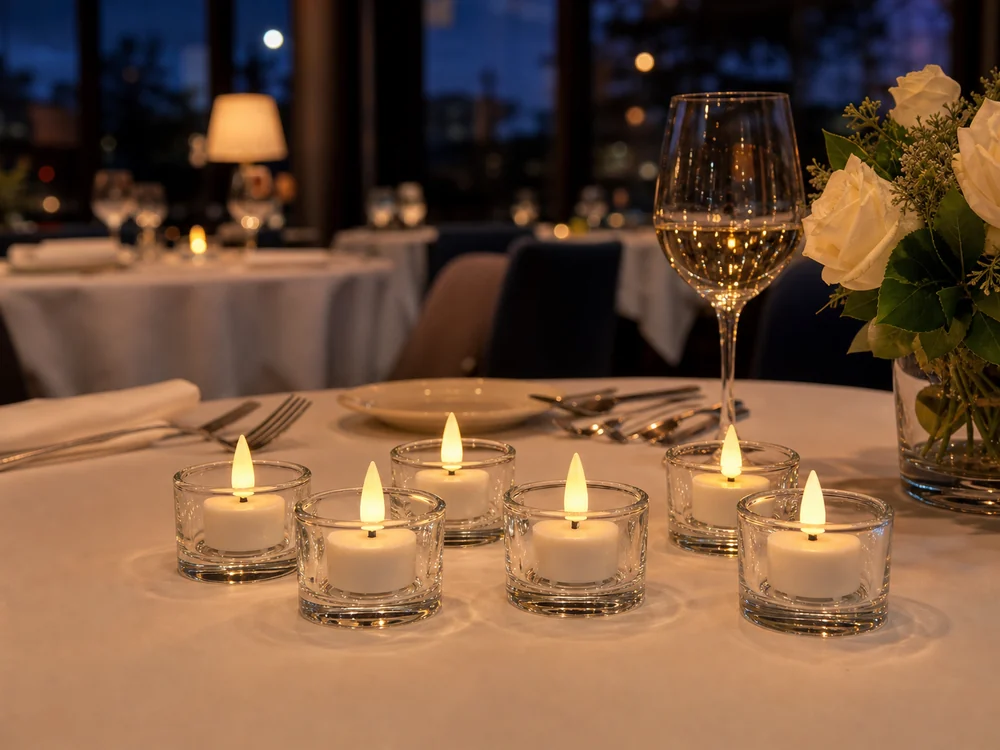
Clear or lightly frosted votive holders can soften the glow while keeping the low white body stable. Deep opaque holders may hide too much light, while narrow glass can trap the unit so tightly that staff cannot remove it quickly. Test the exact candle and holder together before ordering a room-wide quantity.
The LED tip should remain visibly electronic on close inspection. A warm flame-shaped insert gives a familiar silhouette without pretending to be a burning wick. That honest product presentation is especially important when the candle sits within reach of guests, children, sleeves, menus, and table linens.
Choose Warm Light for Food and Faces
Restaurant candlelight should support the room rather than tint every plate orange. Evaluate the tea lights beside the venue’s overhead fixtures, wall sconces, and daylight conditions. A warm LED can feel polished at dinner but overly yellow during brunch if the room already uses very warm lamps.
Photograph one test table with a phone from seated eye level. Look at skin tone, glass reflections, menu readability, and glare on polished cutlery. The camera is not a substitute for seeing the room, but it quickly reveals hot spots and mismatched color that are easy to miss while standing above the table.
Charging Layout Matters More Than Remote Features
A remote is convenient for testing several units, yet the charging station determines whether the system works night after night. Place it in a dry, ventilated staff area with enough outlets and clear cable routing. Avoid a crowded shelf where connectors bend under other supplies or charged lights become mixed with used ones.
Label storage trays by status instead of labeling every candle. A simple charged, in service, and recharge sequence is easier to teach. The aim is to reduce memory-dependent work at closing time, when staff attention is divided among cleaning, cash procedures, and preparation for the next service.
Plan Collection Into Table Reset
Tea lights should have a defined place in the reset sequence. Remove the light before spraying or wiping the table, inspect the holder for chips, and return the unit to the correct tray. This keeps electronic components away from cleaning liquid and prevents a small candle from being wrapped accidentally in used linen.
Private events need a separate count sheet because candles often move from guest tables to cake tables, windows, and lounge areas. Record the starting quantity by zone. A two-minute count before breakdown is easier than searching the room after furniture and floral pieces have already been moved.
Keep Spares and Replacement Rules Clear
Set aside a small reserve that is charged but not placed. Staff should know when to swap a dim unit, when to clean it, and when to remove it from service. A candle with a damaged body, loose charging connection, or inconsistent light should not return to a guest table simply to complete the count.
Use the same candle model within one visible dining zone. Mixing body heights, tip shapes, or color temperatures makes an otherwise careful room look improvised. If the venue expands to another model later, place it in a separate room or bar area where the difference reads as an intentional design choice.
Safety and Service Context
Many venues choose LED products to avoid a burning wick near menus, flowers, sleeves, and crowded tables. The NFPA candle safety guidance gives useful context for open-flame hazards. Electronic tea lights reduce those hazards, but charging equipment and damaged batteries still require sensible handling.
Keep all charging components dry, follow the product instructions, and stop using any unit that becomes swollen, cracked, unusually hot, or difficult to connect. Restaurant staff should report faults instead of improvising a repair. A documented remove-from-service rule protects consistency as well as safety.
Decision Notes for Rechargeable Tea Lights For Restaurants
Measure the display: Measure the internal diameter and depth of every votive holder, then check that staff can lift the tea light out without tipping the glass. Write the dimensions beside the product listing before ordering. This small step prevents a decorative image from overriding holder fit, access, and the true amount of space available.
Identify the likely failure: The common operational failure is not brightness; it is an incomplete charging rotation that leaves one table visibly dimmer than the rest. Planning around the weak point creates a more reliable result than adding features that do not solve the daily problem.
Define the routine: A practical routine assigns one tray to charged units, one tray to used units, and one person to verify the count before the first seating. A repeatable routine is evidence that the product suits the setting. If the process sounds inconvenient before purchase, another power type, pack size, or candle shape may be the better choice.
A Practical Evaluation Worksheet
Create a one-page worksheet before buying rechargeable tea lights for restaurants. In the first column, record only facts visible on the current product page: dimensions, quantity, power source, included controls, timer choices, charging or cell requirements, body material, and light-tip design. In the second column, record facts about the destination: available width and height, holder dimensions, outlet access, moisture exposure, viewing distance, operating frequency, and the person responsible for maintenance. A product belongs on the shortlist only when both columns agree.
Then run a small scene test for rechargeable tea lights for restaurants instead of decorating the whole room at once. Use one holder or tray, photograph the candle while switched off and on, view it from the normal seated or standing position, and practice the full service step. That step may mean lifting the unit for charging, opening a battery door, cleaning a recessed top, or collecting several pieces after use. The test reveals practical friction that specifications alone cannot show, while keeping the recommendation grounded in observable evidence rather than assumptions.
Care, Storage, and Product Review
Wipe the white bodies and translucent LED tips with a dry microfiber cloth, and keep charging contacts free of dust, food residue, and moisture. Protect the light tips from pressure, keep accessories with the set, and stop using any piece with visible damage. Clean condition matters because dust and residue alter both close-up appearance and light spread.
For rechargeable tea lights for restaurants, review the product page again when reordering because pack contents, controls, and specifications can change. This article was checked against current Zabicat listing details on July 13, 2026. The styling recommendations are editorial guidance, not a laboratory performance test or a substitute for the manufacturer’s instructions.
FAQ
How many rechargeable tea lights does a restaurant need?
Count every planned placement, then add a reserve for charging, cleaning, and unexpected table changes.
Can rechargeable tea lights stay inside glass holders?
Yes when the holder fits, remains dry, and lets staff remove the unit without forcing or tipping the glass.
Should every table use a remote-controlled tea light?
A remote is optional. A reliable charging and collection routine usually matters more for daily restaurant operation.
Bottom line: Choose rechargeable tea lights for restaurants only after the size, power routine, electronic flame shape, control method, and maintenance plan all fit the real setting. A clear product match creates better decor and fewer surprises than a purchase based only on a distant glow photo.